Elegant Elegy of Absence
In the stillness of the gallery, fully shielded from the oppressive heat of the midday sun and the incessant rush of urban traffic outside, two strikingly monochromatic exhibits are poised for contemplation within Dimensions Variable. Each, sparingly, is a reflection on mortality. The presence of the color black in both “The Mourner” by Cara Despain and “Do Re Do” by Alexis Martínez functions symbolically:
Black can be used to create a sense of calm and focus.
Black, in some cultures, represents age, experience, seriousness, and a deep understanding of life.
Black is widely associated with funerals and grief in Western cultures as well as professionalism.
Black is often linked to darkness, mystery, and the unknown, sometimes representing villainy and evil.
Lost in a world of dopamine-rewarding distractions, the simplicity and starkness of these presentations stand in opposition to the ease of scrolling, the facility by which we can change the channel. Each artist drives their point home through spare, even withholding, elements. The black ceases the denial of the finality of mortality, that we can’t just hit reset and start over.
“Oh my God… I’m back. I’m home. All the time, it was… We finally really did it. [the actor falls to his knees screaming] YOU MANIACS! YOU BLEW IT UP! AH, DAMN YOU! GOD DAMN YOU ALL TO HELL!! “(PLANET OF THE APES, 1968), so ends the film.
In the movie Planet of the Apes, three human explorers crash on a planet in 3978 dominated by evolved apes. These apes smoke, photograph trophies, drink through straws, and appear civilized.
Their society has three tiers: gorillas as soldiers, orangutans as politicians, and chimpanzees as scientists.
The astronauts become a devalued species, imprisoned by the apes, and later discover they are on post-apocalyptic Earth, destroyed by “maniac” humans. The movie challenges the intelligence and impact of unchecked technology and human evolution in our future and the future of all sentient beings, who, even microscopically, are our neighbors. It raises the topic of anthropocentrism, presenting apes as the intelligent species and reflecting on humanity’s place in nature and the potential intelligence of other species. It is a critique of human arrogance and complacency, and the potential for the crumbling of society as we expect it.
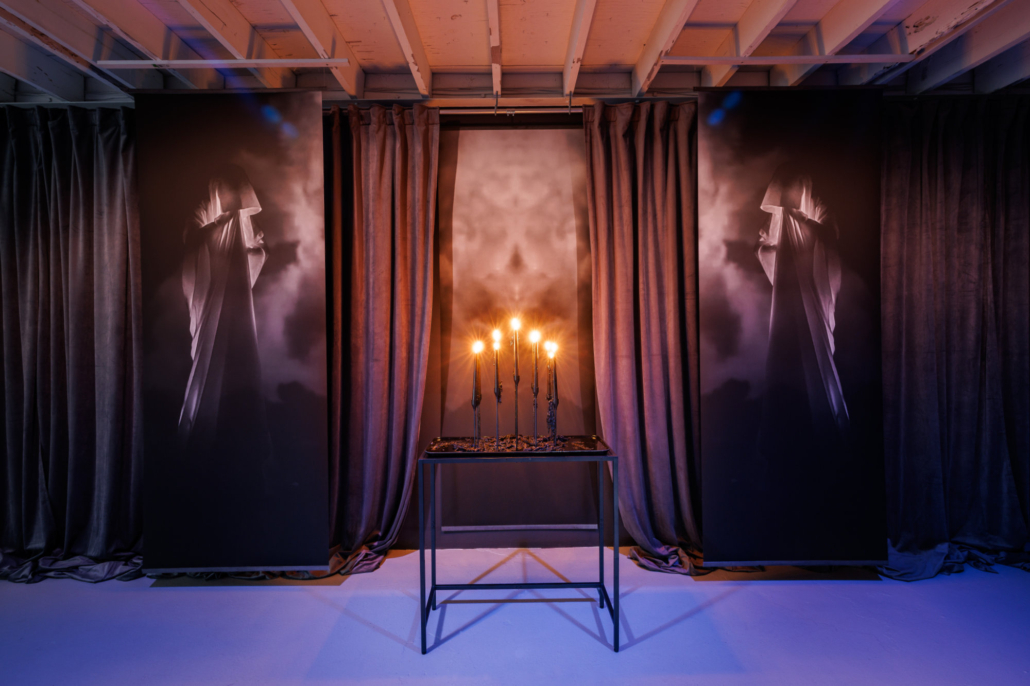
Cara Despain, The Mourner, 2025. Fabric, steel, MDF, ink, paper, Dimensions variable. Installation view at Dimensions Variable, Miami.
—
Each generation finds environmental degradation as some vaguely recent development and imagines that 50-100 years ago we were in a more Edenic-like state here on earth. However, to regard the life and works of John James Audubon and his imperative to document all the birds of North America as a litmus test, it is evident that extinction dates much further back than may have been imagined. His works are omnipresent in Florida on a near-daily basis, populating homes, cafes, and hotels, a reminder of the fragile complexity of life. They are so ubiquitous that we don’t even see them.
Both exhibitions at DV explore themes of loss and the weight of emptiness. In the case of Cara Despain, the loss of our planet as we know it is of ultimate concern. Given the recent un-developments, deregulations, and retractions of environmental protections, her work has evolved from timely and compelling to indispensable, critical, and essential.

Cara Despain, The Mourner, 2025. Fabric, steel, MDF, ink, paper, Dimensions variable. Installation view at Dimensions Variable, Miami.
—
The artist, Despain, is a mixed-media conceptual artist focused on the environmental crisis and the significant issues related to nuclear testing. Over the years, she has used various materials in her works, including “obscure” films from the 1950s and 60s, which aimed to educate the public about protection against nuclear fallout and to garner support for nuclear weapons in the face of communist threats. Her projects explore the development of nuclear weapons originating from the American Southwest, combining both scientific and propagandistic perspectives. This subject is deeply meaningful for Despain, as it relates closely to her family’s history, given that her mother and grandmother were born and raised less than 150 miles from these events. 1
Artists have historically had the freedom to address such issues, bringing them up from under the rug to which they were swept, things outside of the news cycle.
The difficult history and legacy of territorial expansion, industrialization, and empire building in the United States is addressed using sculptural and video-based installations created with found objects and films from the 1940s to the 1960s. She questions our cultural memory and underscores the irreversible environmental consequences and hidden psychological and microscopic health left as a result of nuclear testing.
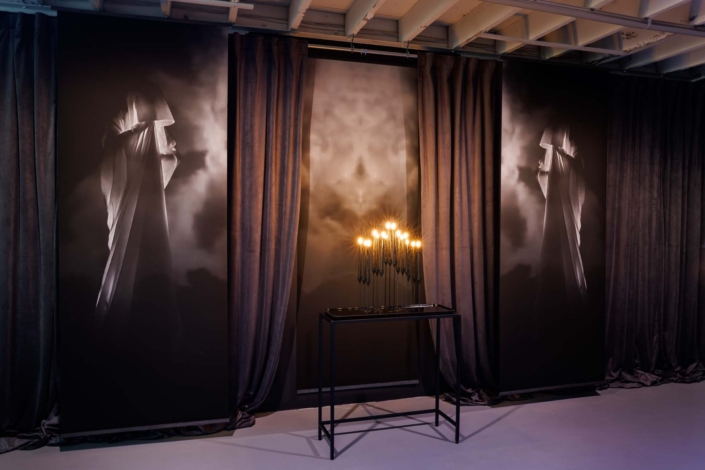
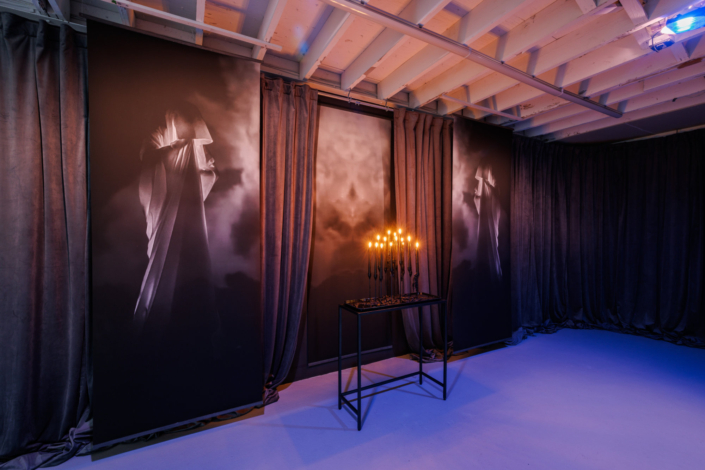
As viewers enter the gallery, they are first confronted with Despain’s installation of a minimalist altar, replete with burning candles. They sit in front of a triptych, bringing a cathedral-like solemnity to the installation and engaging the viewer to relive past experiences. The central panel of the trinity, where historically Jesus or the saints would be, is an abstracted image flanked by large photos. The artist uses burnt debris, which she collects, as the medium, and the imagery is a hazy Rorschach-like abstraction. Malevolent visages emerge from the void with supernatural connotations. These stem from her depictions of atomic explosions, which visually morph into MRI brain imagery here.
The photographic side panels contain a single life-sized hooded figure, thereby creating a universality through facial obfuscation. One panel mirrors the other. By positioning these images to face inward toward the central abstraction, the artist creates a ritualistic installation that functions as a collective location for ecological grief.
Despain intentionally parallels medieval religious art, specifically referencing the alabaster mourner sculptures from the tomb of John the Fearless, also known as Jean sans Peur. She recently came across a catalog of this while at an artist’s residency in Texas.
The artist’s appropriation of the altarpiece format touches on traditional religious iconography by substituting divine figures with the haunting abstraction in the central panel. This bilateral symmetry, a recurring formal strategy in Despain’s oeuvre, uses the human cognitive tendency to perceive faces in abstract patterns. The work operates at the convergence of both ecological and personal loss. Environmental degradation constitutes a form of death. It requires formal processes of mourning, as the artist explicitly intends for anno 2025.
Importantly, while we rely on the environment for our survival, let alone our well-being, it doesn’t share the same dependence on us. This imbalance highlights a significant blind spot in mankind’s collective arrogance, where we often overlook the fragile relationship, a real dependence, we hold with Earth.
While Despain is addressing the exterior world, Martínez, a Cuban artist, goes inward, inside.
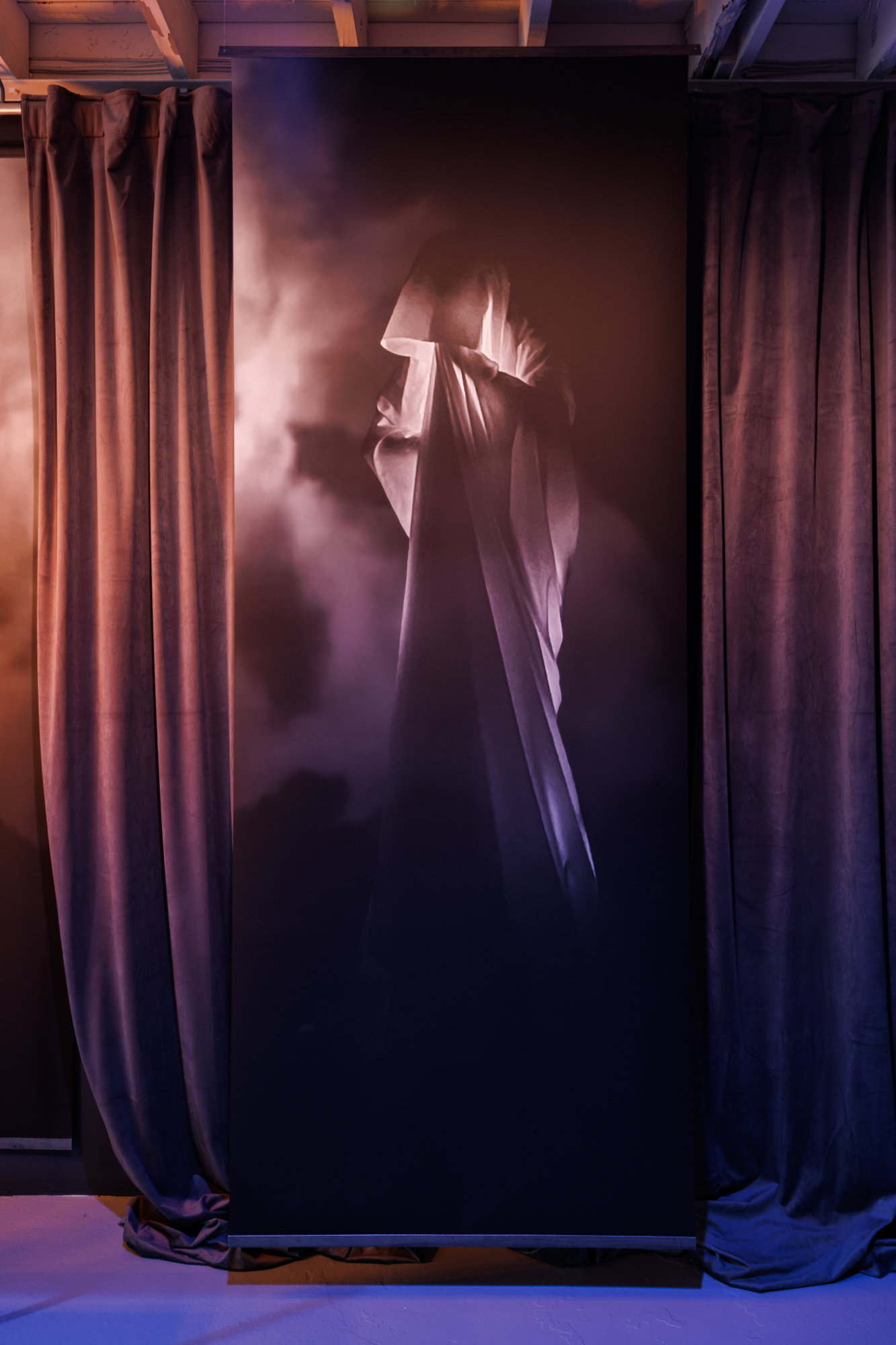
Cara Despain, The Mourner, 2025. Fabric, steel, MDF, ink, paper, Dimensions variable. Installation view at Dimensions Variable, Miami.
—
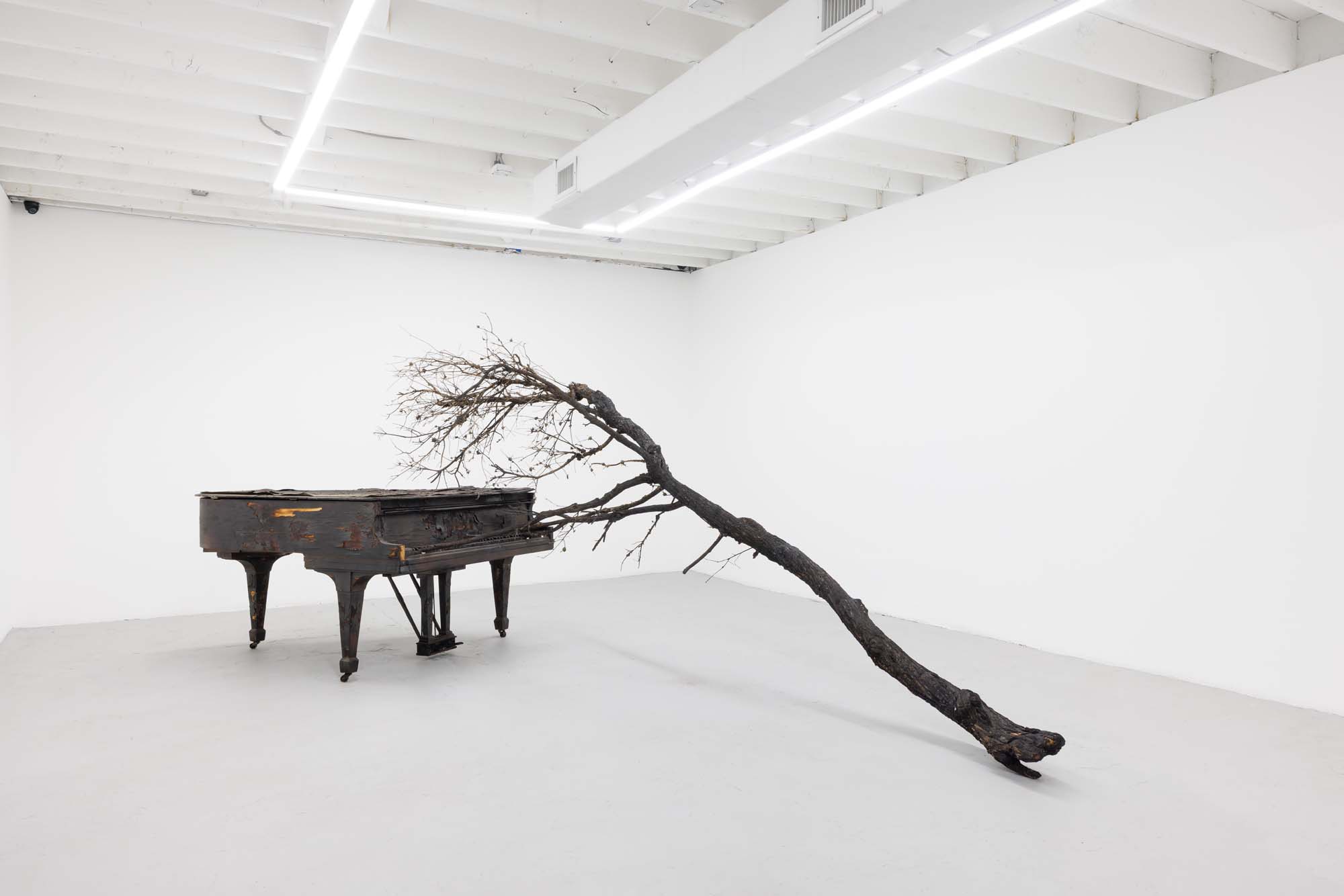
Alexis Martínez, Do Re Do, 2023. Found piano and tree, metal, Dimensions variable. Installation view at Dimensions Variable, Miami.
—
In dialogue with Despain’s installation, Martínez’s “Do Re Do” presents a grand piano in a state of advanced deterioration, with a charred branch resting precisely on specific keys of its fingerboard. So completely and evenly burned, the branch stands in silhouette against the gallery’s white walls. Across the room, a music stand holds yellowed and burned sheet music, the notes of which are indicated and obliterated simultaneously. The depressed keys on the deteriorating piano correspond to the exact notes burned from the sheet music across the room, that of Prokofiev’s Devilish Inspiration. Should the viewer have studied music as a child, these materials may bring a rush of memories, often of frustrations. Aurally, were it to be played aloud, it would recall frantic silent movies, in black and white, of course, in which the frantic hero has not yet saved the soundless damsel in distress.
However, the installation is conspicuously soundless, despite the musical instrument and score.
In the silence is a harkening to the crackle of a fireplace in our collective memory, to the joining of community in the deep of the night.
In the modulated black painting accompanying these sculptures, Martínez used smoke as the medium, the bride of fire. This is evidence of intentionality, a natural process harnessed. These works seem to have been made not by the hand of man but that of time. This juxtaposition of cultural artifact, piano, and branch creates a visual tension that speaks to the relationship between the shared material: wood. As above, so below.
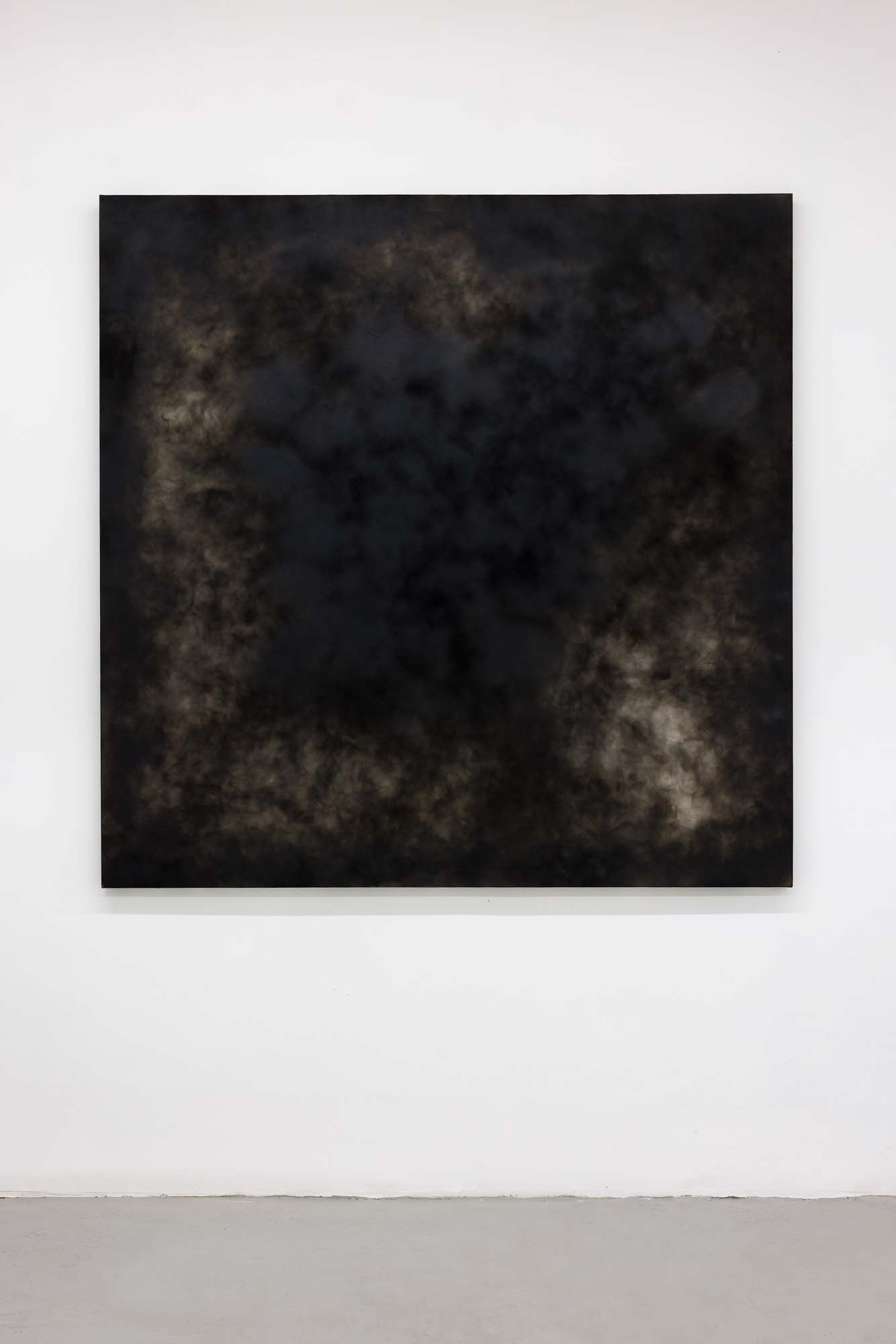
Alexis Martínez, Habit, 2023. Smoke on canvas, 59 x 59 in. Installation view at Dimensions Variable, Miami.
—
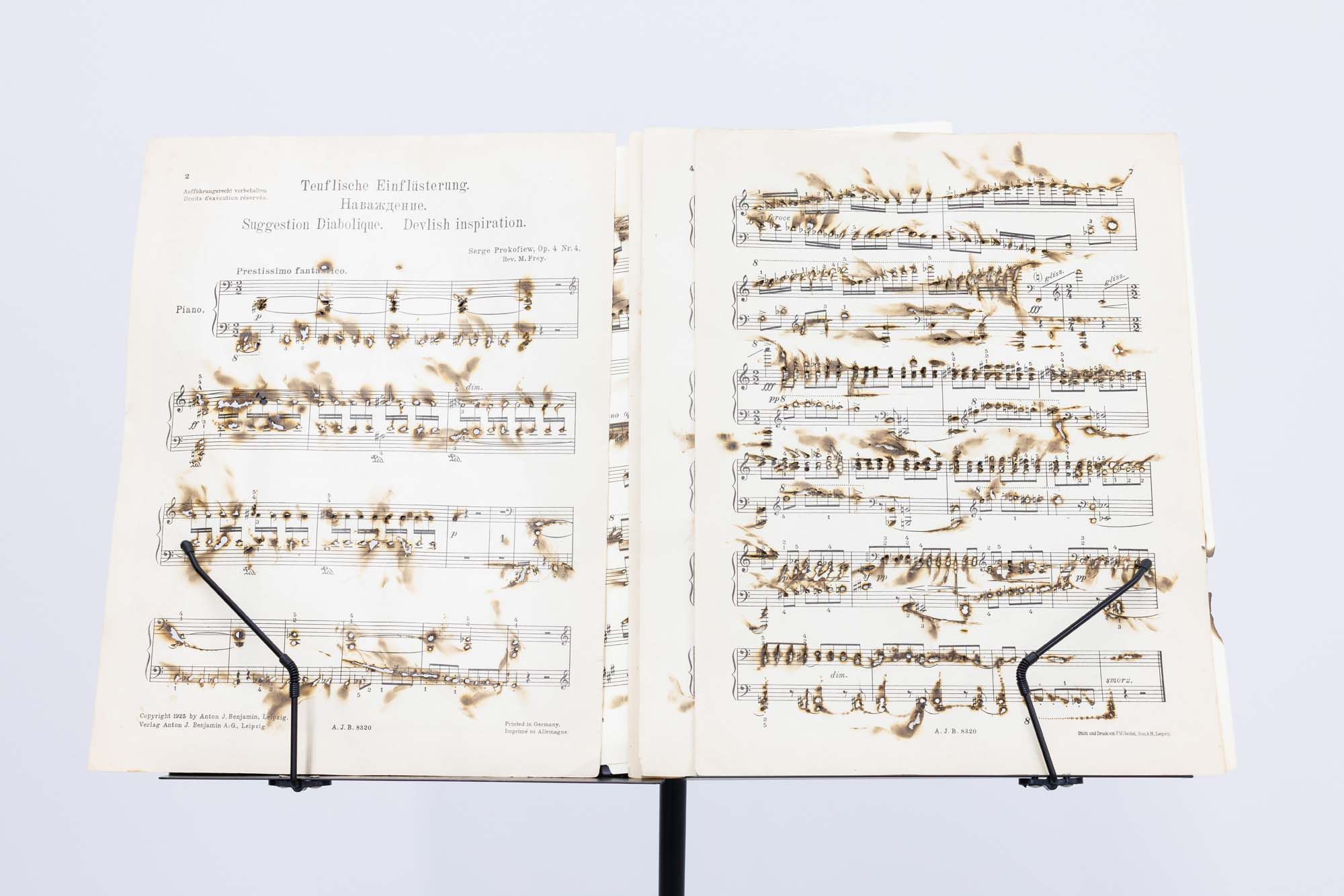
Alexis Martínez, Branch Whispers, 2023. Paper, ink, metal, Dimensions variable. Installation view at Dimensions Variable, Miami.
—
Fire serves as both a medium and a metaphor in Martínez’s work. The deliberate application of burning as an artistic process not only alters the physical state of the material but also steeps the artwork with deeper meaning. By transforming the branch, which once held life and vitality, the process optically flattens the three-dimensional object, which confronts the viewer with a striking visual paradox. This display of time’s destruction is a reflection on the impermanence and fragility of material existence.
The piano is, incredibly and intriguingly, an instrument that has been left outdoors for an extended period, allowing it to deteriorate before undergoing a striking transmutation through its rescue and repurposing. Martínez’s installation embraces both the materiality of the piano without complication and captures what it means to engage with physical objects that have a story to tell. By maintaining a semblance of Minimalism, stripped down in form yet rich in significance, the installation compels viewers to reflect on the layers of time that have shaped the piano’s reduction. The piano’s deteriorated state serves not just as an artifact but as a chronological record, a visual documentation which illustrates the passage of time and the consequences of neglect. The viewer is prompted to consider the beauty that can be found within decay and the profound narratives that emerge from the convergence of time and material.
Martinez’s installation embraces the pristine white gallery walls as active elements in his aesthetic strategy. The stark contrast between the blackened objects and the immaculate surroundings creates a dramatic visual tension that heightens the works’ silhouette-like qualities. This visual approach recalls the formal principles of negative and positive space in traditional artistic composition.
The acoustic implications of Martinez’s installation merit thorough consideration, as they play a crucial role in enhancing the overall impact of the artwork. Though silent in their physical presence, rendering no sound as viewers move through the space, the work evokes powerful sonic associations that resonate within the minds of the observers. Visitors may find themselves imagining the crackling sound of burning wood, as it hisses and pops, merging with the unplayed notes of the piano keys that linger beneath the charred branch, each key holding a story of music absent and emotions unexpressed. This rich, implied sonority creates a tapestry of sound in the viewer’s mind, contributing significantly to the immersive, multisensory experience of the works. It invites viewers not only to engage visually with the striking elements of the installation but also to activate their auditory imagination, pondering what sounds might accompany these silent forms. This layered engagement heightens the complexity of the installations, drawing one deeper into a space where sight and sound, even memories of youth, intermingle for the viewer. Martinez encourages an exploration of time, absence, and the spaces between sound and silence.
Both installations employ formal strategies that evoke religious associations. Despain’s explicit reference to altarpiece structures directly engages with Christian iconography, while Martínez’s piano installation, with its charred branch functioning as a kind of reliquary object, suggests ritualistic significance. They consecrate the gallery space itself, transforming it into a contemplative environment that encourages reflection on loss, daring us to imagine what may be should it all continue on the same trajectory. By drawing on historical religious imagery while addressing contemporary ecological concerns, Despain and Martínez present a black hole of absence and the passage of time. In doing so, they fulfill what Jung identified as the artist’s role: to serve as beacons that reorient society when it has strayed too far into superficiality and materialism, to be a lighthouse when mankind has strayed into a storm. Jung states that the artist must do this work and they refuse to be engaged, it will eat at them and cause them to be restless, irritable, and discontent.
Upon stepping outside again, onto 79th Street, the trees are a little greener, and the air is little fresher. The noise from the passing cars implies that society is still functioning; the Statue of Liberty is not emerging from the sand. Yet, the canaries have been singing in the coal mines for decades. Are we going to step up or scroll down? Will we change the channel to change our mood, procrastinating inconvenience? But extinct is forever, and you can’t hold your child with Nuclear Arms.
—
- The world’s first nuclear explosion took place in New Mexico on July 16, 1945, when a plutonium implosion device was tested at the Alamogordo Bombing Range. This event occurred along the Jornada del Muerto, which means “Dead Man’s Journey” or “Route of the Dead Man “. The trail was part of the Camino Real de Tierra Adentro, established by Spanish conquistadors, leading northward from central colonial “New Spain”. The detonation was code-named “Trinity,” creating a nuclear fallout zone that spanned over 150 miles, affecting the entire ecosystem and all nearby residents. Communities in the region have been exposed to radioactive contamination from testing, mining, and human error. Furthermore, it ultimately affected the entire globe forever.

Erin Parish
The artist, curator and writer Erin Parish has lived in Miami Beach since 2006, following two decades in New York City. While in New York she worked at Galleries and as an artists assistant until starting to be in the studio full-time in 2000. She holds a BA from Bennington College and an MFA from CUNY/Queens College. Earlier in her career, she studied art in pre-unification Berlin, Germany.
Her work explores subatomic patterning and its presence in natural forms. She focuses on circles, cells, and molecules, often using orbital structures as a visual language.