Start with a body that’s also the Internet. Then swap this body for a screen that’s also a poem. Coat this screen in self-tanning solution. Stick a credit card to it. Add a comb and some S-hooks. Don’t forget to rub it all in. Next, expose this ensemble to UV light and let it cook until it has developed a nice, rich tone. Now peel off the comb, the S-hooks, the credit card. And voila, like a magic trick, the body has returned, golden and glowing.
A pithy sensibility of ersatz wonder permeates Liz Rodda’s exhibition, “Bronze,” at Dimensions Variable and reminds me of the pleasure I often obtain from chancing across a rainbow in an oily puddle of water. Dirty, trippy, a little bit sentimental. Humor, of the absurd variety, is also present, especially in Jacuzzi (2023), a video wherein a stationary camera records a jacuzzi running through its program of party lights and jet stream features for no one to enjoy. Added to the mix is a stained work-shirt the artist has provided as apparel for the video monitor, resulting in a combination that both humanizes the commodity and commodifies its bare-chested personality. To me, Jacuzzi has the comedic timing of a Steven Wright or Mitch Hedberg one-liner, the kind of joke that lands because of the space the comedian has left around it. Surrounding all of Rodda’s work is a body-shaped space the artist alludes to obliquely by way of fingerprints, smudges, flung shirts, or accessories, which is all perfectly fine with me. Because that space makes things interesting.

Liz Rodda, Jacuzzi, 2023. Video, sound, Dimensions variable. Installation view at Dimensions Variable, Miami.
—
I’m thinking of Rodda’s Transfer (2025), a video of a sunset from a moving train. The camera doesn’t move, it just records this sunset, which produces across the sky a soft, gradient glow from blue to violet to orange. Except we don’t see this sunset straight on. We see it reflected through a laptop screen stained with oily fingerprints, and I love that. It’s sacred and profane at the same time, which is how things really are. Rodda’s videos also elicit a sense of stoned obsession wherein, after prolonged observation, things start to signify other things. It is as if the camera’s dead-eyed stare reifies its subject into an assisted readymade, infinitely exchangeable in a symbolic economy. And in Rodda’s economy, it seems to me as though the general equivalent—that arbiter of value without which nothing matters—is the artist’s darling of an obsession, the sun.[1]
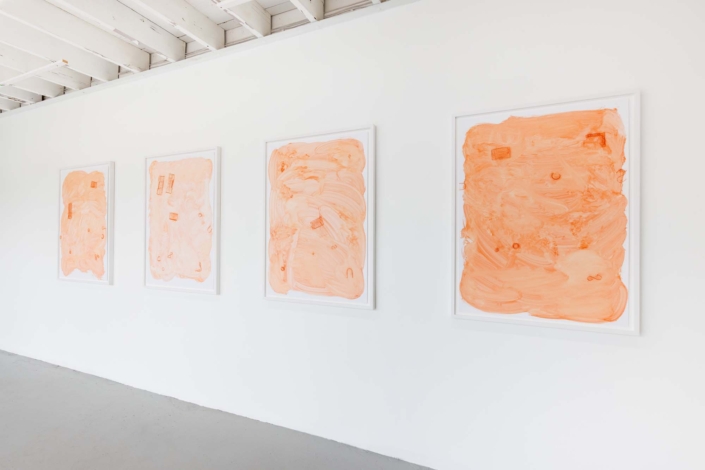
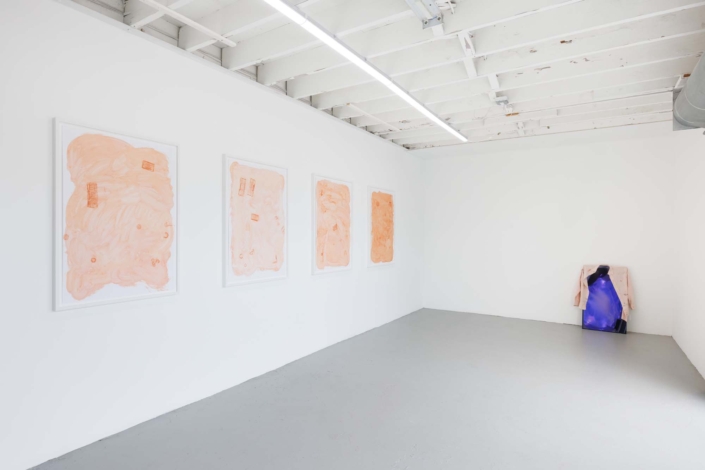
The sun really takes center stage in Rodda’s Rubbings (2024), works on paper which remind me of cyanotypes, cameraless photographs made by resting objects upon emulsified paper and then exposing this to sunlight. In Rubbings, though, photographic emulsion is swapped for self-tanning solution, and the imprinted objects include a credit card, combs, and other tools and accessories now indexed within the picture plane. What to make of this? Are these traces of household objects the peeled away results of a peculiar sunburn? Ouch.
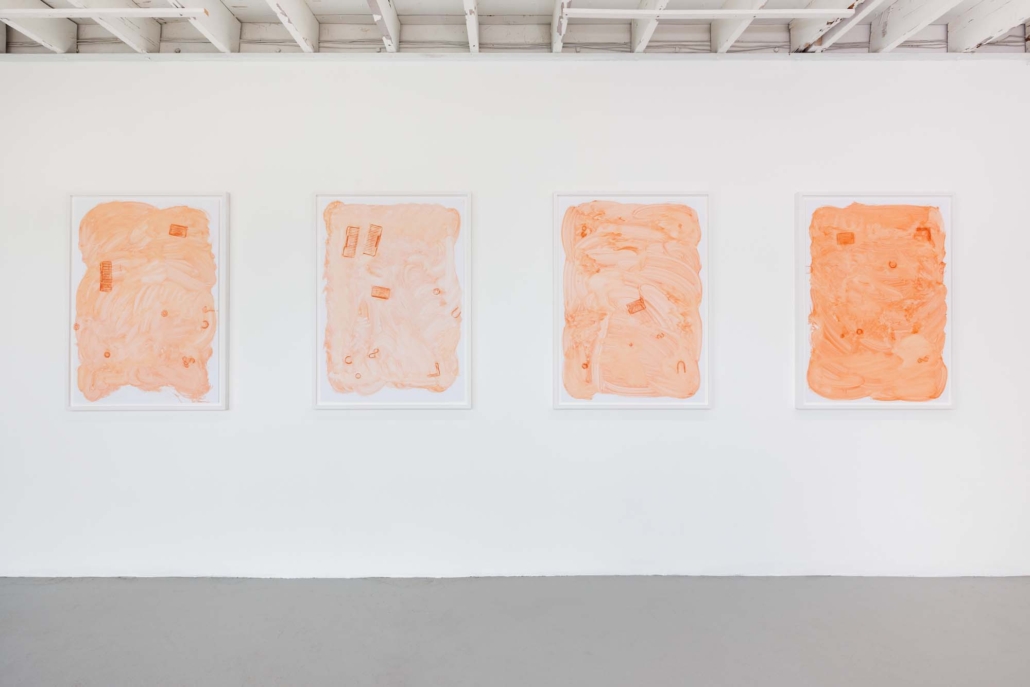
Liz Rodda, Rubbings (Series of 4), 2025. Self-tanning solution, pigment, and drawing stick on paper, 31 ¼ x 43 in. Installation view at Dimensions Variable, Miami.
—
They’re sort of like Rauschenberg’s Combines; I’m thinking of Bed (1955) for which the artist used his quilt and pillow as a canvas to make what resembles a kind of postmodern self-portrait. It’s a critique of the figure/ground relationship, where the picture plane is a bed the artist sleeps in or eats in or fucks in or just exists in, rather than a surface they project on. We see the artist in the picture even when we don’t see the artist because their stuff provides all the information. I think a similar operation is happening in Rubbings, someone’s definitely in there but we won’t find out who by asking formalist questions.
These artworks also make me think of Isa Genzken’s sculptures that incorporate mannequins and cheap consumer products such as radios, hardware, or plastic knick-knacks, giving convincing form to the phrase you are what you buy. But Rodda’s Rubbings don’t have the same anthropomorphic qualities of Genzken’s sculpture—they’re monochromes—and they’re basically flat. It’s as though the figure has melted into the picture, leaving behind the residue of random objects once carried in their pockets. And the instigator of this transformation—what this whole exhibition keeps alluding to—is the sun.
In The Accursed Share, Georges Bataille takes the perspective that our world is overflowing with an abundance of energy, beginning, first and foremost, with the solar energy produced by the sun.[2] There is always more energy to spend than can be consumed and so the way each society spends its surplus energy (its wealth) says a great deal about its values. The fingerprints and rubbings, jacuzzi jet streams, and dirty sunsets in “Bronze” could be mistaken for mundane, insignificant, or simply absurd expenditures of energy, but what if these were viewed from within a paradigm of excess? Isn’t this the stoner’s philosophy? Or the schizophrenic’s? The world could in fact be exploding right this very second with a kaleidoscopic excess of meaning, value, and energy, if you want it to be.
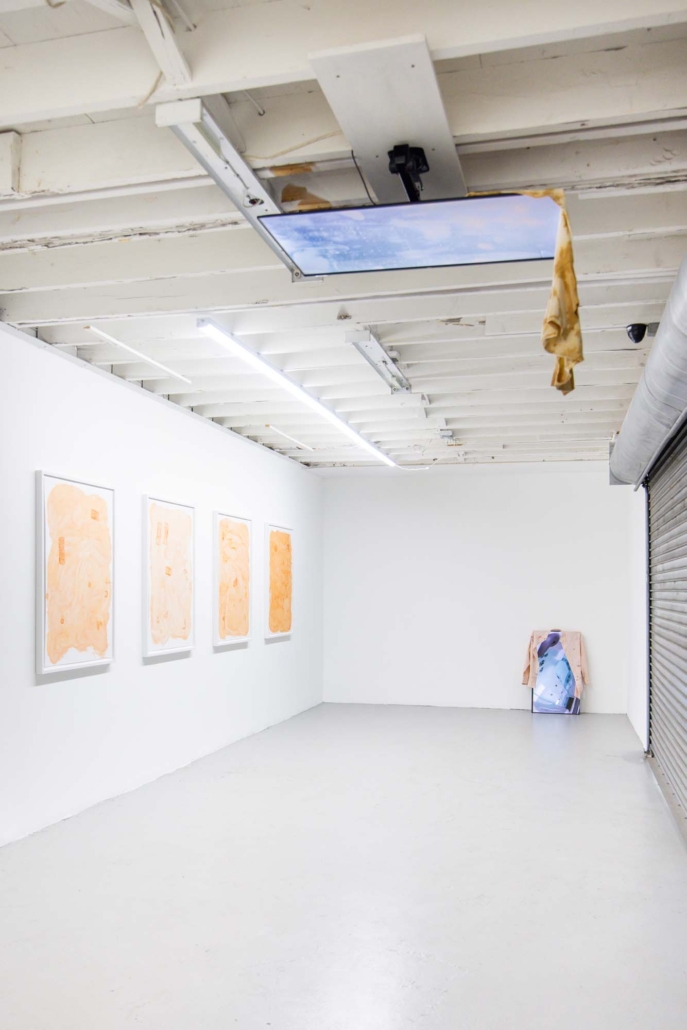
Liz Rodda, Bronze, 2025. Installation view at Dimensions Variable, Miami.
—

Liz Rodda, Bronze, 2025. Installation view at Dimensions Variable, Miami.
—
It seems clear enough that the sun in this constellation of artworks is the general equivalent, the big cheese, the absent (celestial) body that makes it all run, gives every object its value within Rodda’s symbolic economy. I like that. It makes me think of these artworks as a kind of offering, you know, potlatch. A vital and luxurious waste of time, energy, and resources for the sake of ceremony, fulfillment, and energy transfer which, here, is based on a helio-centric logic. And, of course, there is a human body skirting around the edges of these artworks, which seems important but not that important, maybe they’re the high priest facilitating the sacrifice. I’ve only been to Miami once, but I’ve always imagined that the sun is a pretty big deal there, like a celebrity people love to talk about. That’s why “Bronze” makes sense in Miami. It’s for the real ones, the true believers, the ultimate heliophiles.
—
[1] For a comparative analysis of other general equivalents—such as the Father, the Phallus, Money, and Language—see Jean-Joseph Goux, Symbolic Economies: After Marx and Freud (Ithaca, New York: Cornell University Press, 1990).
[2] Georges Bataille, The Accursed Share: An Essay on General Economy, trans. Robert Hurley (New York: Zone Books, 1988).
Max Tolleson
Max Tolleson is a critic-in-residence at the Core Program: Museum of Fine Arts, Houston, and has published scholarship and art criticism with Artnet News, ASAP/J, Glasstire, and Panorama. While living in Marfa, Texas, he researched and wrote about the history of the Chinati Foundation in relation to minimalism, environmental theater, critical regionalism, and the politics of display; he has presented his research at the Getty Foundation and the Whitney Museum of American Art. In 2024, Max curated Mimi Bowman: RINSE at The Car Wash (Houston, TX) and in 2025 he curated The Middle of Somewhere at the MFAH. Max received a PhD in art history from the University of California, Los Angeles and was a 2022-2023 Helena Rubinstein Critical Studies Fellow at the Whitney Independent Study Program in New York City.