You’re Welcome to Stay
It’s one of the most familiar sentences in the language of hospitality. It is said at a door, at the end of an evening, by someone who holds the house. Its warmth depends on a quiet authority, because only those who belong to a place can invite another to remain in it. You’re Welcome to Stay takes the sentence at its word and asks who has the standing to say it.
The roadside motel was built for people who would not stay. Along Biscayne Boulevard, the old route into the city before the interstate carried the traffic elsewhere, motels were made to be seen from a moving car: a sign, a pool, a row of doors, a room left behind the next morning. Robert Venturi, Denise Scott Brown, and Steven Izenour read this roadside architecture as a language addressed to the driver passing at speed.¹ Over time, many of these rooms took on another life. They became homes for people who stayed by the week or by the month, when the city offered them nowhere else. A building designed for passage came to be held by those who remained.
Jacques Derrida, following the linguist Émile Benveniste, traced the words for host and guest back to a shared root in power and mastery. For Derrida, hospitality can never be separated from sovereignty over one’s own home.² To offer welcome is to claim the right to give it. In this exhibition, that right belongs to the artists. The visitor enters rooms already inhabited by people who make their lives and their work along this road, and the invitation comes on their terms.
bell hooks described homeplace as a space of care and resistance, built by those the wider world declined to shelter, where community is made and dignity restored.³ The rooms of You’re Welcome to Stay are offered in that spirit. The welcome is generous and sincere, and it is also a statement of place. The hosts are not leaving. The invitation is theirs to extend.
—
Notes
- Robert Venturi, Denise Scott Brown, and Steven Izenour, Learning from Las Vegas, rev. ed. (Cambridge, MA: MIT Press, 1977).
- Jacques Derrida and Anne Dufourmantelle, Of Hospitality, trans. Rachel Bowlby (Stanford: Stanford University Press, 2000).
- bell hooks, “Homeplace (a site of resistance),” in Yearning: Race, Gender, and Cultural Politics (Boston: South End Press, 1990), 41–49.
Details
Feria Clandestina 2026—Room 221
Join DV at Feria Clandestina 2026, Room TBA. Thursday, December 3 through Saturday, December 5. Featuring artists Ray Azcuy, Carola Bravo, Carla Fache, Sarah Henderson, Natalya Kochak, Ana Martinez Orizondo, Karen Starosta-Gilinski.
–
Fair Hours—
Thursday, December 3, 12—11:00 pm
Opening Party, 6—11 pm
Friday, December 4, 12—7 pm
Saturday, December 5, 12—7 pm
Muu Blanco
Muu Blanco, whose real name is José Antonio Blanco Angulo, is a Venezuelan multidisciplinary artist known for his work in music, visual arts and performance. He was born in Caracas and has developed a notable career both nationally and internationally.
Blanco began his artistic career in the 1980s. He studied at the Armando Reverón University Institute of Higher Studies of Plastic Arts (IUESAPAR) in Caracas, where he specialized in visual arts. His visual work includes painting, sculpture, video art and photography. He is known for his installations and performances that explore themes of identity, politics and popular culture. His style is characterized by strong social criticism and a more conceptual than technical approach.
Moonth Exchange
Guided by lunar cycles, the Moonth Exchange is a collective that practices a form of alchemy through correspondence, exchanging materials, objects, and ideas between the Iowa prairie and Florida tropics. Their evolving practice explores the intersections of art, folklore, mythology, transformation, and the absurd through collective experimentation and making.
The Moonth Exchange is an ongoing collaboration between Sarah Henderson, a photographer and visual artist based in Miami; Cynthia O’Hern, a figurative fiber artist based in Des Moines; and Veronica O’Hern, a multidisciplinary artist working in assemblage, Victorian hairwork, and writing based in rural Iowa.
Carla Fache
Carla Fache is a Chilean born, Miami-based visual artist who explores through her paintings the frontiers of color. Color is essential in Fache’s work. Her paintings have been widely recognized for their energy and vibration. Her command of color and texture, creates a distinctive language to reveal powerful links with higher dimensions, allowing the viewer to visit through her canvas, these new timeless realities.
Her more recent exhibitions include: Fondazione Giorgio Cini di Venezia, Florida Museum for Women Artists, Celeste Prize at The Invisible Dog Art Center, New York, Armory Art Center, Palm Beach, Cambridge Art Association, Boston, Locus Projects and All- Media Juried Biennial Art and Culture Center of Hollywood. Some of the places where her work has been exhibited are: Cisneros Fontanels Arts Foundation, The Bass Museum of Art, Deering Estate at Cutler, Lowe Art Museum, Museum of Contemporary Art and Coral Gables Museum to mention a few.
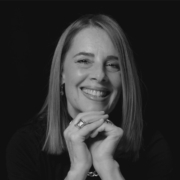
Carola Bravo
Carola Bravo is a Venezuelan-American multidisciplinary artist, architect, educator, and cultural activist based in Miami, Florida. Her artistic practice encompasses drawing, immersive site-specific video installations, and public art, exploring the geometry of space and its intersections with history, memory, and time. Through her work, she investigates themes of change, identity, home, exile, and hope, reflecting on the ways we inhabit, experience, and establish connections with our surroundings. Her interest in landscapes, spaces, and territories informs an artistic language rooted in geometry, dimensions, scale, proportion, and the physical and conceptual elements that define a place.
Her solo exhibitions include Theater of Spaces (2025), Miami Dade College, Kendall Campus Gallery, Miami; Inhabited Geometries (2019), Bernice Steinbaum Gallery, Coconut Grove; Blurred Borders (2016), Patricia and Phillip Frost Art Museum, Miami; and We Are Where We Are Not (2013), The Screening Room, Miami. Her work and artistic contributions have been featured in publications including The Wall Street Journal, El Nuevo Herald, and ArtNexus.
Bravo has received numerous awards and recognitions, including the Miami Individual Artist Grant (2023, 2024), The Ellies Creator Award (2023), and the Bass New Monuments Award (2022). She has also been commissioned to create more than ten public artworks throughout Florida, integrating her artistic vision with architecture, urban environments, and community spaces.
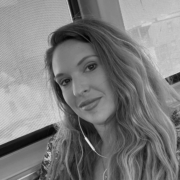
Natalya Kochak
Natalya Kochak is a multidisciplinary visual artist whose practice engages language, history, and material process as interrelated systems. Born in New York, she lived across multiple regions of the United States before settling in Miami in 2014, where she has maintained an active studio and teaching practice for over a decade. Kochak received her BFA (2005) and MFA (2018) from the School of the Art Institute of Chicago. Her practice centers on the examination of printed texts and archival sources, which she deconstructs and reconfigures into physically and conceptually layered surfaces to examine how cultural narratives are transmitted, stabilized, and revised over time.
Across studio practice, installation, and pedagogy, she employs confrontation as a generative strategy—inviting reflection, responsibility, and critical re-reading—while material decisions, rather than illustrative storytelling, guide the structure and pacing of her work. Since establishing her practice in Miami, Kochak has sustained a strong commitment to education and public-facing engagement within Miami-Dade County. From 2018–2019, she was an artist-in-residence with ProjectArt, working with displaced teenagers and park district students at the Liberty City Library. From 2019–2023, she taught in the Visual Arts Department at Miami International University, and she currently serves as an adjunct professor of art history at Barry University, teaching courses spanning prehistory through contemporary global art.

Ana Martinez Orizondo
Ana Martínez Orizondo is a Cuban-born multi-disciplinary, self-taught artist based in Doral, Florida. Her work spans visual art and writing. Ana has exhibited in group shows at Doral Cultural Art Center (2025), Miami Art Week 2024, Feria Clandestina 2023, Miami International Fine Arts (MIFA), in New York at The Painting Center, View Center for Arts and Culture, East End Arts, and online at The Curator’s Salon and Visionary Arts Collective, among others. She collaborated with fashion designer, Gabriela Hearst on her Fall Winter 2022 collection and was the inaugural artist-in-residence at The Chequit, Shelter Island with a solo show of over twenty-five pieces from her Tree Stories series. Ana was also a resident artist at Miami International Fine Arts in Doral, Florida 2023.
Ana’s work is part of private collections and has been featured nationally and internationally in Vogue Mexico & Latin America, The Cut, Cottages & Gardens, Shelter Island Reporter, Art Seen Magazine, and The Hopper Magazine prominent publications.
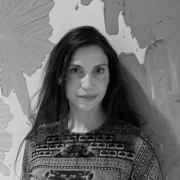
Karen Starosta-Gilinski
Karen Starosta-Gilinski was raised in Caracas, Venezuela and born in Minnesota, USA in 1982. She holds degrees from the Accademia Del Giglio in Florence, Italy, and a BFA from Miami International University of Art & Design, graduated Cum Laude. Her practice incorporates found objects and altered materials, as well as comforting objects such as clay on canvas, plush toys and recycled objects to create a variety of assemblages and sculptures that are humorous, provocative to touch and heartfelt. She has had solo exhibitions at the Design District Dacra’s Melin Building, granted by former Miami Design District, Craig Robin’s collection and program curator, Tiffany Chestler. Starosta-Gilinski’s has exhibited twice at The Moore Building, supported by Design District DACRA. She has exhibited at the Art Culture Center of Hollywood, curated by Jane Hart. The Frost Art Museum, curated by Klaudio Rodriguez, former executive director of the Bronx Art Museum, NY, and now executive director and CEO of the Museum of Fine Arts St. Petersburg.
Her group shows include David Castillo Gallery, The Bass Museum, Coral Gables Museum & The Freedom Tower, curated by Sonia Becce, also at Bakehouse, curated by former MOCA chief curator, Bonnie Clearwater, and Primary Los Angeles. A commissioned sculpture is in the permanent collection at the Patricia and Phillip Frost Art Museum. Some international shows include London, Venezuela & Shanghai Art.
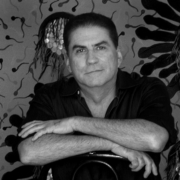
Ray Azcuy
Ray Azcuy is a Cuban-American artist who lives and works in South Florida. He received a BA and MA from the University of South Florida, Tampa, Florida. He is a recipient of the South Florida Cultural Consortium Fellowship for Visual and Media Artists, the John F. Kennedy Center for the Performing Arts Summer Fellowship/Residency, Washington, D.C. and Atlantic Center for the Arts Fellowship/Residency, New Smyrna Beach, Fl. His works are in corporate, private and museum collections including the Perez Art Museum Miami (PAMM) Miami, Fl., NSU Art Museum, Ft. Lauderdale, Fl., The Sackner Archive of Concrete and Visual Poetry, Miami, Fl., the Miami International Airport, Miami, Fl. and the Orlando Airport, Orlando, Fl. Azcuy’s work has been in various solo and group exhibitions including New Art South Florida, MOCA at Goldman, Miami, Fl., Cintas Foundation Fellowship Finalists, MDC’s Museum of Art + Design, Miami, Fl., Big Juicy Painting (and More), Miami Art Museum, Miami, Fl., the Art of Assemblage, NSU Art Museum, Ft. Lauderdale, Fl., PUSH PLAY Redefining POP, Jacksonville Museum of Contemporary Art, Jacksonville. Fl., Salvador Dali Museum, St. Petersburg, Fl., The Moore Space, Design District, Miami, Fl., Selby Gallery, Ringling College of Art and Design, Sarasota, Fl., St. Petersburg Art Center, St. Petersburg, Fl., Aesthetics & Values, Frost Art Museum, Florida International University, Miami, Fl., Miami-Dade College, Kendall Campus, Miami, Fl., mia Gallery, Miami International Airport, Miami, Fl. Additionally, Azcuy has taught visual arts at the secondary and college levels and was visual arts supervisor and director of museum magnet programs for Miami-Dade County Public Schools.
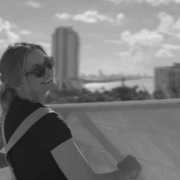
Barbara Roca
Her love for the arts started in Paris more than 25 years ago, and it hasn’t stopped since. There, Barbara took painting and drawing lessons at the Parsons School and classes with various Parisian painting masters.
Later she relocated back to Santa Cruz Bolivia, her hometown, to start a large production of paintings from 1998 – 2004 while exhibiting around the country and studying printmaking at NUR University. In 2004, she moved to Miami and worked at Frederic Snitzer Gallery. She graduated in 2012, with a double major in Graphic Design and Digital Media from the University of Florida. She obtained her Museum Studies Certificate at Florida International University (FIU) in 2015.
She assisted at the Ruth and Marvin Sackner Archive of Concrete and Visual Poetry from 2012 to 2016. In September 2015 she opened the ABC Silkscreen shop, where she helped creatives make their printed-related projects come alive.
She enrolled in the MFA in Visual Arts: Curatorial Practice at FIU and continues to work on her art practice, acrylic paintings on canvas and oil painting commissions while being a sales advisor and promoter for artists of the southern globe.